


I’ve been in the SEO trenches for over a decade. I remember the panic when Penguin hit, the scramble during Mobile-First indexing, and the collective groan when voice search didn’t quite take over the world as predicted. But what we are facing in 2026 isn’t just an algorithm update; it’s a fundamental platform shift.
If you’re still obsessing over “blue links” and slightly tweaking your Title Tags to improve CTR (Click-Through Rate) by 0.5%, you are fighting a war that ended two years ago.
The reality? The volume of traditional search is projected to drop by 25% this year. Users aren’t just “Googling it” anymore; they are having conversations with Perplexity, asking ChatGPT for advice, and letting automated agents handle their shopping.
This is the dawn of Agentic SEO and Generative Engine Optimization (GEO).
The goal is no longer just to get a human to click a link. The goal is to convince a machine that you are the absolute, undeniable source of truth so that it cites you in its generated answer.
In this guide, I’m going to walk you through exactly how to pivot your strategy. We aren’t just summarizing the state of the industry; we are building a battle plan for the Business-to-Machine (B2M) economy.
I. The New Paradigm: From Link Hunting to Influence Optimization
Let’s rip the band-aid off: The “Click” is losing its status as the ultimate Key Performance Indicator (KPI).
For years, we optimized for the click. We wrote click-baity titles and meta descriptions designed to entice a human eye. But in an era where AI Overviews (AIOs) intercept the user’s intent and answer the question before a result is even loaded, the click is becoming a rarity.
This is what I call “The Great Cannibalization.” AIOs satisfy the user immediately. If you are ranking #1 but your content is summarized perfectly by Google’s Gemini or OpenAI’s ChatGPT, you might get zero traffic.
Does that mean you lose? Not necessarily.
The Shift to “Inclusion”
In 2026, success is measured by Inclusion Rate and Share of Conversation. If an AI agent recommends your product to a user—even if the user never visits your website—that is a conversion win. You need to be the entity the AI trusts enough to mention.
Here is how the landscape has shifted, and trust me, you need to memorize this difference:
| Feature | Traditional SEO (The Past) | Agentic SEO & GEO (The Mandat 2026) |
| Main Goal | Rank high to earn human clicks. | Be the synthesized answer. Get cited. |
| Optimization Unit | The Full Page (URL-level). | The Passage (Chunk-level, atomic answers). |
| Primary KPI | CTR & Organic Traffic. | Inclusion Rate & Semantic Share of Voice. |
| Authority Signal | Backlinks (PageRank). | E-E-A-T, Brand Mentions, & Digital PR. |
| Audience | Humans searching for links. | AI Agents searching for data. |
If you take nothing else from this article, take this: You are no longer writing just for people. You are writing for the machines that serve the people.
II. Pillar 1: Deep Structure and Machine-Readable Content
To win at Agentic SEO, you have to understand how Large Language Models (LLMs) consume content. They use a process often referred to as RAG (Retrieval-Augmented Generation).
They don’t read your site like a book cover-to-cover. They “chunk” it. They look for specific vectors of information that match a query. If your content is buried in fluffy introductions or complex HTML tables, the RAG system will ignore it.
The “Answer-First” Imperative
I see this mistake constantly. A blog post titled “How to Fix a Leaky Faucet” starts with 300 words about the history of plumbing.
Stop doing that.
To win the retrieval game, you need Cognitive Clarity. Every single page on your site should start with a direct summary (40-60 words) that explicitly answers the main intent of the keyword. This is your “citable chunk.” It’s the soundbite the AI will steal and present to the user.
Modular Design: The Atomic Approach
Think of your content as Lego bricks, not a solid wall of text.
- H2s and H3s are critical: Each heading should be a question or a clear statement that acts as a standalone unit.
- Granular Formatting: Keep sentences short (under 20 words). Use paragraphs of 2-4 sentences.
- Lists are King: AI agents love bullet points and numbered lists. They are easily parsable. If you are explaining a process, use a numbered list. If you are comparing features, use bullet points.
Warning: Avoid HTML tables for critical data if possible, or support them with clear text summaries. RAG systems sometimes struggle to ingest complex table structures linearly.
Schema.org: The AI Translation Layer
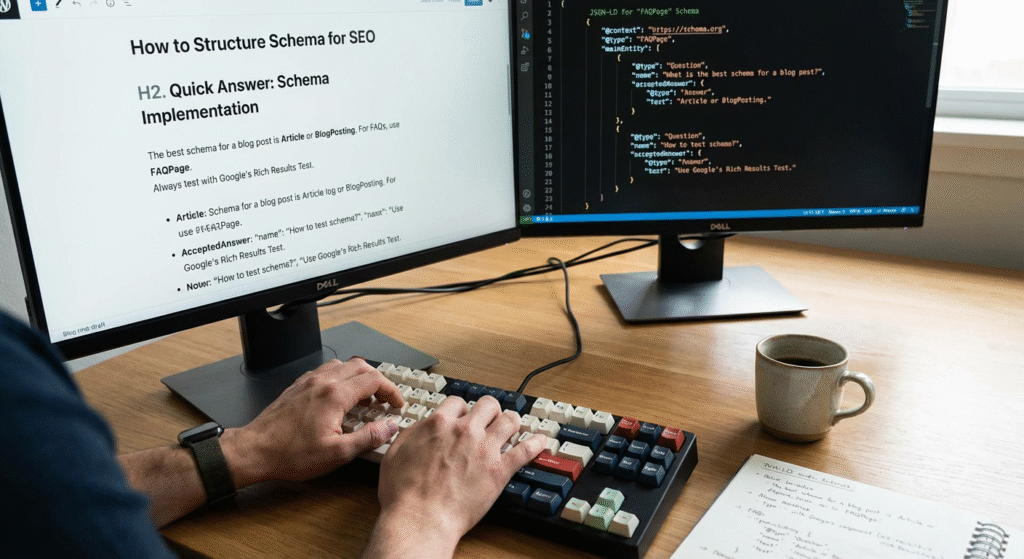
You might think Schema is old news. It’s not. It’s the Rosetta Stone for Agentic SEO. Since AI agents don’t “see” your website design, they rely on the code to understand relationships.
- Organization Schema: This establishes your brand as a verified entity.
- Person Schema: This links the content to a human expert (crucial for E-E-A-T).
- FAQPage Schema: Even though Google dropped the visual snippet, the code remains a goldmine for RAG ingestion. It literally formats your content into Q&A pairs—the exact format LLMs use.
Preparing for the “Agentic” Crawlers
We are seeing a rise in new bots: GPTBot, ClaudeBot, and others. These agents are ruthless. They generally do not render JavaScript. They want raw text.
If your site relies on heavy client-side rendering (React, Angular) without server-side rendering, you are invisible to the new wave of Agentic SEO crawlers. Prioritize site speed, text-based navigation, and clean HTML semantic tags like <article> and <aside> to give these bots a roadmap.
Furthermore, look into implementing llms.txt. This is an emerging standard—a file similar to robots.txt but specifically designed to tell LLMs what content on your site is high-value for training and citation.
III. Pillar 2: Authority 2.0 (E-E-A-T) and the Human Moat
Here is the irony of the AI age: The more content is generated by machines, the more valuable human experience becomes.
Google and other platforms use E-E-A-T (Experience, Expertise, Authoritativeness, Trustworthiness) as their primary filter against AI hallucinations. If an LLM is going to cite a source, it needs to be 99.9% sure that source isn’t making things up.
Experience: Your Secret Weapon
As a Small-to-Medium Enterprise (SME) or a niche blogger, you cannot out-generate ChatGPT. But you have something it doesn’t: Physical Reality.
AI cannot taste food. It cannot test a vacuum cleaner. It cannot feel the texture of a fabric.
To rank in 2026, you must lean heavily into the first “E”—Experience.
- First-Person Language: Use “I tested,” “We discovered,” “In my opinion.”
- Original Media: Stop using stock photos. Photos you took yourself (even messy ones) carry more weight as “proof of life” than polished stock images.
- Proprietary Data: Run your own mini-studies. If you sell coffee, survey your 100 customers about their favorite roast and publish the data. That is unique information that the AI must cite you to reference.
Digital PR: The New Link Building
Backlinks still matter for Google’s PageRank, but for LLMs, Mentions are the new currency.
We call this “Influence Optimization.” If Reddit, Quora, industry forums, and major publications are talking about your brand, the LLM associates your brand name with the topic.
- Community Sources: Did you know that nearly 48% of citations in AI search results come from community platforms like Reddit and YouTube? You need a strategy for these platforms. You can’t just spam them; you need to participate.
- The “Best Of” Strategy: You need to get your brand mentioned in “Best of” lists on high-authority sites. When a user asks an agent “What is the best CRM for real estate?”, the agent looks at the consensus across the web. If you are mentioned in 5 out of the top 10 articles, you win the recommendation.
Freshness as a Trust Signal
LLMs are terrified of being outdated. A distinct bias exists toward content updated within the last 12 months (roughly 70% of citations).
You cannot publish and pray anymore. You need a “Content Governance” plan where high-value articles are refreshed quarterly. Add a “Last Updated” date and—crucially—add a note at the top explaining what you updated. This signals to the crawler that the freshness is substantive, not just a date change.
IV. Pillar 3: The “Search Everywhere” Bifurcated Strategy
We used to have one strategy: “Please Google.” Now, the landscape has split. You need a dual-pronged approach because the platforms behave differently.
Strategy A: Winning Google’s AI Overviews (The Rank-First Model)
Despite the hype, Google is still Google. There is an 81.1% correlation between ranking in the traditional Top 10 and being cited in a Google AIO.
- The Play: Stick to the fundamentals. Good technical SEO, strong backlinks, and the “Answer-First” structure we discussed. If you fall off Page 1, you likely disappear from the AIO entirely.
Strategy B: Winning ChatGPT & Perplexity (The Presence-First Model)
This is where it gets wild. These LLMs often cite sources that don’t rank in the top 10 of Google. They care less about PageRank and more about semantic relevance and brand entity strength.
- The Play: Focus on “Search Everywhere.”
- Build a robust presence on YouTube (video transcripts are ingested by LLMs).
- Optimize your Pinterest boards (visual search is huge).
- Ensure your LinkedIn and Twitter/X profiles are active and authoritative.
- Create a Wikipedia page or a Wikidata entry if possible.
These platforms act as “validation nodes” for the LLMs. If ChatGPT sees you exist on Google, YouTube, LinkedIn, and Crunchbase, it assigns you a higher “Entity Trust Score.”

V. Infrastructure for the Agentic Age (B2M & Commerce)
If you are in eCommerce, the stakes are even higher. We are moving toward Agentic Commerce.
Imagine a near future where a user says to their phone: “Find me a pair of running shoes under $120 that are good for flat feet and in stock near me.”
The AI agent (the buyer) goes out to fetch this data. If your website serves this information inside a slow-loading page wrapped in marketing fluff, the agent will bounce.
API-Ready Data
Your product data (Price, Inventory, Specs, Shipping) needs to be exposed via structured data or, better yet, open APIs.
You need to facilitate Business-to-Machine transactions.
- Real-Time Inventory: Agents prioritize sites that show accurate “In Stock” status.
- Flat Specs: Ensure your product descriptions have a clear “Specifications” section that is purely factual. The agent doesn’t care about your “soul-stirring design philosophy”; it cares about the weight, material, and dimensions.
New KPIs for a New World
How do you report success to your boss or client in this brave new world?
- AI Presence Rate: Track how often your brand appears in AI answers for your core keywords (tools like various SEO platforms are starting to offer this tracking).
- Sentiment Analysis: It’s not enough to be mentioned; are you mentioned positively? If the AI says “Brand X is popular but known for poor battery life,” that is a negative win.
- Conversion Velocity: People referred by AI agents tend to convert faster because the “research phase” was handled by the bot. Monitor the time-to-purchase for this traffic segment.
FAQ: Navigating the Agentic Future
Q: Is traditional SEO dead?
A: No, but it has been demoted to a “foundational layer.” You still need technical SEO (crawling/indexing) for the bots to find you. But you can no longer rely only on keywords and backlinks to win.
Q: How do I optimize for Agentic SEO specifically?
A: Focus on structured data (Schema), clear “Answer-First” writing styles, and exposing your data via APIs or clean HTML. Make it easy for a robot to “read” and “understand” your site without human intervention.
Q: What is the difference between GEO and SEO?
A: SEO is about ranking a list of blue links. GEO (Generative Engine Optimization) is about optimizing content to be synthesized into a single, coherent answer provided by an AI.
Q: Can I block AI bots from scraping my site?
A: You can (via robots.txt), but in 2026, that is business suicide. Blocking GPTBot or ClaudeBot means you are voluntarily removing yourself from the world’s fastest-growing information sources. Unless you have a paywalled media model, let them in.
Q: How long does it take to see results from GEO?
A: It can be faster than traditional SEO for “Inclusion,” but building the Entity Authority required to be a “Trusted Source” takes time—usually 6 to 12 months of consistent content and PR work.